


- Coworking
- Events
Mapping the Coworking Joining Journey: Tips from the Coworkies x Nexudus Workshop
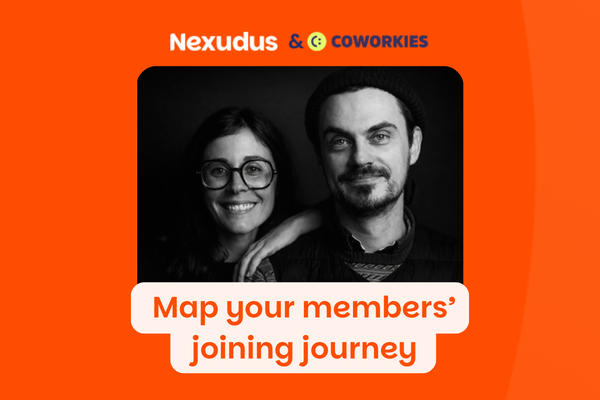
We recently teamed up with Pauline and Dimitar from Coworkies for a live workshop focused on a part of the member lifecycle that’s easy to overlook: the joining journey.
This is everything that happens before someone signs a membership agreement – the moment they first hear about your space, the website visit, the email exchange, the tour, and that crucial first day.
Across just over an hour, operators from around the world shared their own friction points, and Pauline and Dimitar shared joining journey tips and a framework for turning small, overlooked moments into opportunities to stand out. Here’s what we took away.
People join you earlier than you think
When asked when members actually “join” a coworking space, most operators in the room pointed to touchpoints further down the funnel. But Pauline and Dimitar suggested the real answer is much earlier: the first time someone sees a photo of your space online, reads a review, or simply asks themselves, “could this be for me?”
They framed this as two distinct phases: discovery (the moment your brand enters someone’s world – through search, social media, word of mouth) and first contact (when they actually reach out). Every touchpoint within these phases – a photo, a review, a loading webpage is a small decision point where a prospect either feels reassured or feels friction.
The framing that stuck: discovery is potentially the most fragile part of the entire member journey, because the relationship isn’t sealed yet. Prospects don’t know you, so even small inconsistencies can feel like red flags.


The friction points that quietly lose you members
Pauline and Dimitar shared examples gathered from visiting over 600 coworking spaces — small moments that, on their own, seem minor, but collectively shape whether a prospect continues or drops out.
Some of the most common:
- Broken links on websites or social media — dead Instagram pages, expired form links, or social accounts that haven’t posted in months, all of which can make a space look inactive or untrustworthy.
- Arriving for a booked tour to find no one at reception, particularly jarring for spaces without a staffed front desk.
- Pricing that’s hard to find, especially for private offices, leaving prospects unable to gauge whether a space is even in their budget.
- Sign-up forms that ask for too much information up front, discouraging prospects who are still just browsing options.
- Slow or generic follow-ups after first contact, which can set the wrong tone before a relationship even begins.
The useful distinction here was between frictions and failures — frictions being small annoyances (a broken link, a slow reply), and failures being moments where the prospect’s experience diverges so much from what they expected that they disengage entirely. Either way, the fix often starts with the same exercise: regularly testing your own links, forms, and contact paths the way a prospect would.

Applying Airbnb’s “11-star experience” framework
The centerpiece of the workshop was the Airbnb 11-star framework Pauline and Dimitar have used in their consulting work for years, originally developed by Airbnb co-founder Brian Chesky.
The idea:
A 5-star experience is simply meeting expectations – you book an Airbnb, and it looks like the photos and runs smoothly.
A 6-star experience adds small, unexpected touches – a welcome gift, toiletries in the bathroom.
A 7-star experience is more personalised – the host already knows you like surfing and has arranged a board and lessons.
And an 11-star experience is something so far beyond expectation that it becomes a story you tell for years (their example: Elon Musk picks you up and takes you to space instead of your Airbnb).
Applied to coworking, the framework becomes a way to audit your own friction points and ask: what would a 5-star fix look like, versus a 7-star one? For example, if a prospect struggles to understand your membership pricing online, a 5-star fix might be reorganising and clarifying your pricing pages. A 7-star fix might use AI-assisted tools to dynamically show prospects only the membership options relevant to them, based on what they’ve clicked or asked about.
The most practical takeaway, though, was this: don’t aim for 11-star on day one. Instead, ask what 10% of your 7-star idea could look like – something achievable now. A custom welcome video for every prospect might be the 7-star dream; a single, well-made introductory video featuring your team might be the realistic version that still moves the needle.
Best practices across the booking journey
Pulling from their work and the discussion in the room, Pauline and Dimitar offered a set of practical recommendations, organized by touchpoint:
For your website and online presence: show people, not just empty desks and meeting rooms – populated spaces feel warmer and more inviting. Make it obvious who your space is for. Use video where possible – even a single team member explaining who the space works best for can make a big difference in how prospects perceive a “generic” template-based site.
For first contact
Respond quickly, since speed often signals professionalism. Keep emails sounding human rather than visibly AI-generated or overly templated. Set clear expectations about what happens next – for example, sharing parking information, pricing, and FAQs proactively so prospects don’t have to ask.
For tours
Take time to learn who you’re meeting (a CFO will have different questions than an assistant booking on someone else’s behalf) and tailor the conversation accordingly. Let visitors get comfortable – offer them water, let them set down bags and jackets before diving into the tour itself. Use storytelling rather than just listing amenities; people remember anecdotes about how members met collaborators or grew their businesses far more than they remember square footage.
For post-tour follow-up
Do what you said you’d do, when you said you’d do it. Reference specific things discussed during the tour so prospects feel the follow-up was made for them, not copied and pasted. Where possible, give them a reason to come back – an invitation to an event, for instance.
For the first day
Avoid letting new members arrive anonymously. A simple internal “who’s arriving today” reminder can help teams greet people by name. Cover the basics immediately – Wi-Fi, access systems, and how to book a meeting room so new members aren’t left guessing, and look for an early win by asking directly what they need help with.

Getting discovered by AI
One of the more forward-looking points from the session was about how AI tools are increasingly being used by prospective members to research and shortlist coworking spaces. Dimitar shared an observation from testing AI search tools: in at least one case, the AI explicitly avoided relying on Google reviews because it considered them too easy to manipulate, drawing instead on a broader range of sources – blogs, videos, social media, and press coverage to build a picture of a space and its community.
The implication for operators is that the content you publish online – interviews with members, recaps of events, coverage of the types of companies based in your space isn’t just for human visitors anymore. It’s also shaping how AI tools understand and potentially recommend your space when someone asks for a coworking recommendation that fits their needs.

Bringing it together
A theme that ran through the whole session was the balance between technology and human touch. As Pauline put it, technology’s role in the discovery phase should be to inform, remind, automate what can be automated, and guide prospects through the journey, while the human role is to welcome, connect, reassure, and occasionally surprise.
For coworking operators, the discovery journey isn’t a single moment – it’s dozens of small ones, many of which are easy to overlook because they happen outside the four walls of the space itself. But as the workshop made clear, even small improvements to these moments can shift a prospect’s experience from forgettable to memorable.
Want to know more about
how Nexudus could help your business?
We’re here to answer any questions you have.
Latest articles
-

- Coworking
- Coworking Resources
Practical AI Lessons for Coworking Operators from GWA Denver 2026
Damian on October 1, 2026 -

- Coworking
- Coworking News
- Technology
AI didn’t add a feature to coworking software. It’s rewriting what the product is.
Jane Robathan on September 30, 2026 -

- Coworking
Advanced Coworking Analytics: When Standard Reports Fall Short
Emily Nguyen on September 15, 2026