


- Coworking
- Coworking Resources
How to Fix Your Coworking Sign-Up Process

Most onboarding problems begin before the process starts in earnest.
We’re talking about the signup stage. If it’s messy or chaotic, it’ll work against you.
A coworking signup flow that is poorly structured and misinformed creates confusion and friction from the get-go, impacting everything from billing and bookings to daily usage.
If pricing, terms or memberships are unclear or outdated, you’re creating more work for your team: as well as increasing the workload, it leaves a bad impression on members.
But a simple, structured coworking signup ensures that both the correct information is captured and the member’s expectations are clear before payment is taken and onboarding begins.
Let’s get into it.
Reduce Administrative Corrections
Has your team ever had to change a membership type for someone the week after signup?
Do they regularly clarify billing cycles and resend contracts? Or do they – and this is a super common one – have to explain meeting room credit rules relentlessly?
If the answer is ‘yes’ to any of the above, your signup process is transferring operational work to staff. Each correction is a signal that the decision path wasn’t structured clearly enough.
The objective is not to eliminate human contact altogether.
It’s about spending time on meaningful interactions over avoidable corrections.


What a Coworking Sign-Up Process Should Include
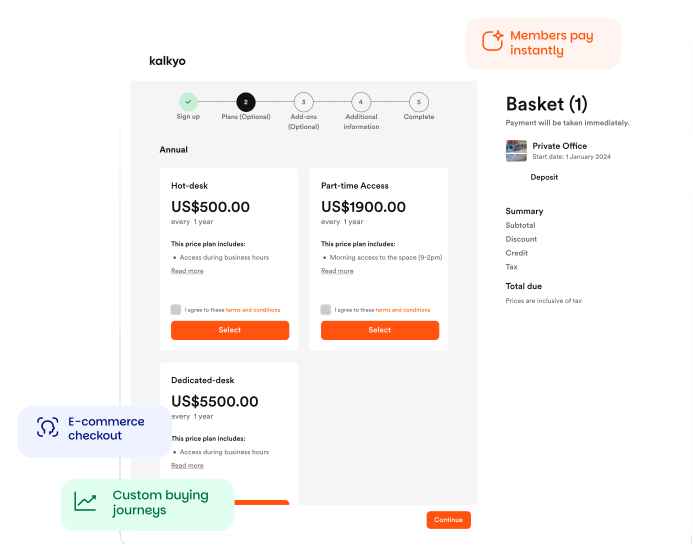
You should treat your signup process as the main decision facilitator; it should guide members towards the best membership for their needs, while eliminating ambiguity by clarifying what they’re agreeing to before payment is taken.
At the very minimum, it should:
- Clearly define membership types
- Present accurate pricing and billing frequency
- Show what is included and what is not
- Capture required legal and billing details
- Present terms before payment
If this process is fragmented, or if any steps, like T&Cs, are delivered later on, the structure is incomplete and confusion creeps in. Your coworking signup flow should run smoothly.
When it flows well, the journey starts with clean, accurate and usable data.
Capture Only What You Need at Purchase
It’s a question of balance: don’t ask for too much or too little.
If you don’t ask for enough information your team will have to pick up the slack later on. (When staff chase missing information after payment, the issue is rarely the member). But ask for too much and the prospective member is more likely to abandon the signup process.
Think about the information you need at signup versus what can wait until afterwards.
Here are some examples:
Required at purchase
- Legal name – The customer’s full official name used for identification and billing.
- Billing details – Payment and address information required to process the transaction.
- Company name (if applicable) – The registered business name if the purchase is made on behalf of a company.
- Agreement to terms – Confirmation that the user accepts the terms and conditions.
Can be completed after login
- Profile enrichment – Additional information to improve and personalise the user profile.
- Extended company information – More detailed business data.
- Marketing preferences – The user’s choices about receiving promotional communications and updates.
Providing short explanations, tips, or examples next to fields can help users understand what’s required. This can reduce mistakes and the need for staff to manually correct or follow up on incomplete or incorrect information submitted by new members.
Make Entitlements Explicit Before Payment
Be clear about what’s included in each membership plan – members shouldn’t have to infer what they’re entitled to. Clarity at this stage reduces disputes and avoids repeated explanations later.
Your sign-up process should clearly communicate:
- Desk access type
- Meeting room credits or allowances
- Access hours
- Cancellation terms
- Upgrade paths
It’s possible to include all the relevant information on your website without overcrowding the page. For instance, you can use expandable sections – also known as accordions – to show more detailed information. Alternatively, you could use ⓘ info icons beside features to show short explanations when the website visitor hovers or clicks on the icon.
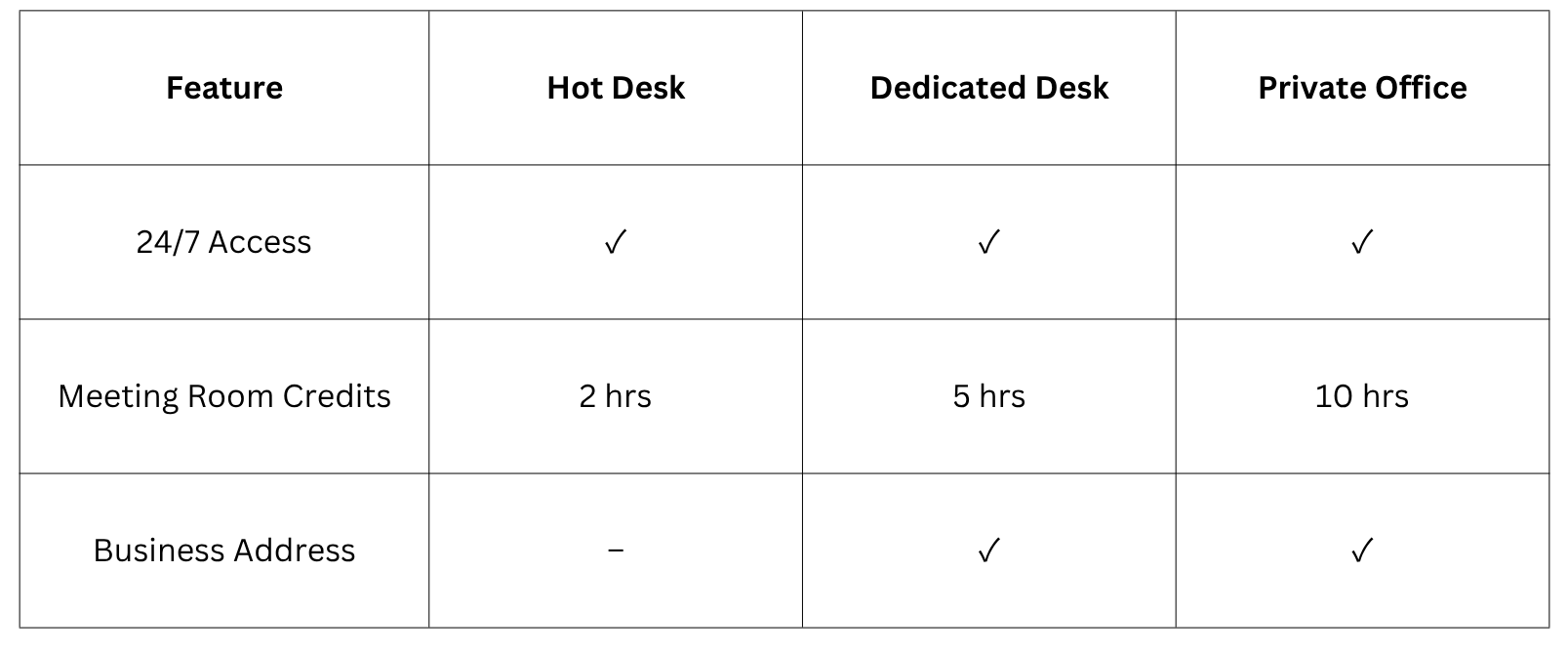
Better still, display plans in columns and features in rows so users can scan quickly.
Here’s a quick example:
Connect Sign-Up Directly to Your Onboarding System
Fragmented signup processes result in more abandonments.
Each step shouldn’t sit in isolation, but be viewed as part of a whole.
When signup, billing and onboarding systems operate separately, inconsistencies emerge. When connected, members move from purchase to active use without confusion. A structured signup process works best when it feeds directly into a defined onboarding workflow.
Connecting your signup form directly to your onboarding system means user information will automatically create a member profile and trigger the next onboarding steps.
The signup form sends the data to the onboarding system through an API or backend integration, which automatically creates a member record and triggers onboarding workflows.
The membership type selected should immediately reflect in your Member Portal. Billing terms presented at checkout should match your usual invoicing logic. And accepted terms should be stored and retrievable from – you guessed it – the Member Portal, as well as email.

Review Your Process as a New Member
They say you learn best by doing. So, run a simple test!
Complete your own coworking sign-up process as if you were a prospective member.
Ask yourself:
- Is pricing clear before payment?
- Are terms visible and unambiguous?
- Is the information requested proportionate?
- Does confirmation reflect exactly what was selected?
- Would you need to ask any follow-up questions?
If the answer to the last question is yes, your structure needs refining.

Why This Matters Beyond Day One
Issues at the signup stage have a funny way of filtering into the member journey. Moments of confusion can resurface days, weeks or even months down the line.
Take unclear membership types, for instance.
A member who signs up for a hot desk membership might think they can reserve the same desk every day, when the plan actually includes flexible seating arrangements. When they try to book the same desk repeatedly, they might feel like they’re been unfairly restricted.
Inevitably, staff end up intervening to explain the policy or adjust the membership type.
Other members might be confused about how they’re billed, due to unclear billing terms. One might not understand that meeting room credits reset monthly, while another may not realise that VAT is added. Again, this creates additional administrative work later on.
Another common issue involves unclear entitlements, which can lead to dissatisfaction. For instance, if a plan includes four meeting room hours per month but this is not clearly communicated at signup, the new member might feel disappointed when they reach the limit.

Summary
Your coworking signup process sets the operational foundation for the member journey.
When it captures the right information, presents terms clearly and connects directly to onboarding infrastructure, members move forward independently.
When it leaves gaps, staff compensate and inconsistencies accumulate.
Designing a structured sign-up process is intuitive with a CRM for coworking. It centralises member data and ensures it’s captured consistently from the start.
Instead of juggling different data points, navigating spreadsheets and managing individual signups, the system automatically triggers onboarding actions – including access setup and welcome communications – so you can focus on creating the best coworking experience.


Want to know more about
how Nexudus could help your business?
We’re here to answer any questions you have.
Latest articles
-

- Coworking
- Coworking Resources
Practical AI Lessons for Coworking Operators from GWA Denver 2026
Damian on October 1, 2026 -

- Coworking
- Coworking News
- Technology
AI didn’t add a feature to coworking software. It’s rewriting what the product is.
Jane Robathan on September 30, 2026 -

- Coworking
Advanced Coworking Analytics: When Standard Reports Fall Short
Emily Nguyen on September 15, 2026