


- Coworking Resources
- Technology
AI in Coworking: From Machine Learning to AI Agents
TL;DR
Nexudus has evolved its use of AI from early machine learning models that forecast demand and improve pricing to generative AI assistants and intelligent AI agents that automate support, bookings, and sales. Rather than following AI trends, the focus has been on solving real operational challenges – helping coworking operators increase revenue, improve member experiences, and work more efficiently. The next step is proactive AI that anticipates needs and recommends actions before users even ask.
In this guide we’ll explore:
- How AI entered coworking
- Where operators are using AI today
- Practical use cases
- AI agents
- Automation
- What’s coming next
The conversation around AI has accelerated dramatically in recent years, but at Nexudus, our journey with AI began long before it entered the mainstream.
It all started with a simple question:
How can we use technology to help coworking operators make better decisions and deliver better experiences?
For us, evolving AI has never been about chasing trends. It’s been about solving real operational challenges and finding practical ways to help coworking operators work smarter. Looking back, the evolution of AI at Nexudus reflects how the industry itself has changed – from early machine learning models to today’s AI agents.
Today, AI is embedded across many areas of our platform, from forecasting demand and optimising pricing to improving support and streamlining sales. But the journey has been intentional and focused on delivering measurable value and outcomes.


The beginning: understanding how spaces are used
Around 2020, after nearly a decade in the flexible workspace industry, we began taking a deeper look at the vast amount of data generated across our platform.
We wanted to better understand how people use flexible workspaces, from meeting room bookings and occupancy trends to member engagement and retention.
One of our earliest discoveries was a shift in meeting room utilisation. Comparing industry data over time and specifically after Covid, we noticed the way people use meeting rooms and phone booths in coworking spaces changed.
This raised an important question:
Could operators better understand and predict demand in order to optimise their spaces?
To answer it, we developed a machine learning forecasting model that analysed historical booking data and predicted future meeting room demand. The model could identify recurring patterns such as weekly booking trends, seasonal fluctuations and the impact of bank holidays.
For operators, this provided a clearer picture of how resources were being used and where opportunities for optimisation existed. It was one of the first steps in our own AI evolution and demonstrated the value of turning operational data into actionable insights.

From forecasting to dynamic pricing
Once operators could understand demand patterns, the next step was helping them act on those insights.
In 2022, we introduced Dynamic Pricing for meeting rooms. Inspired by models commonly used in hospitality and aviation, it allows operators to adjust prices based on expected demand.
Prices can increase during busy periods, decrease during quieter times, or offer incentives for last-minute bookings. While this approach was relatively new to the flexible workspace sector, it demonstrated how data-driven insights could directly support revenue optimisation.
More recently, with the launch of our new Members Portal, we’ve made Dynamic Pricing more transparent. Members can now clearly see pricing changes and understand the value they’re receiving when making a booking.
Understanding member engagement and retention
Another challenge facing workspace operators is retention.
To better understand what influences member tenure, we developed a Member Engagement model that used machine learning to analyse behavioural indicators such as attendance, meeting room usage and spending patterns.
These signals were combined into a health score that helped operators identify highly engaged members, spot potential churn risks and uncover opportunities to strengthen retention.
Building on this work, we also explored advanced Marketing Insights. By grouping members with similar characteristics (i.e, private office members, hot-desking members, etc), operators could better understand different customer segments and identify opportunities for engagement, retention initiatives and upselling.

Enter the Generative AI era
The launch of ChatGPT marked a major turning point for the industry.
One of the first areas where we saw immediate value was customer support. Many support requests are repetitive, covering topics such as Wi-Fi access, printing instructions or opening hours.
To address this, we introduced AI-powered Help Desk automation. Operators can build a knowledge base of frequently asked questions, allowing AI to provide instant responses when members submit support requests through the platform.
The result is faster response times, reduced support workloads, and a better experience for members, with answers available 24/7.
This phase of the AI evolution demonstrated how generative AI could be applied to everyday operational challenges, not just experimental use cases.
Nexudus AI: Bringing intelligence directly into the platform
In 2024, we launched Nexudus AI (NAI), our AI assistant built directly into the platform.
NAI allows operators to interact with Nexudus using natural language. Whether finding invoices, accessing reports, reviewing bookings or managing members, users can simply ask a question rather than navigating through menus or documentation.
Today, Nexudus AI answers hundreds of queries every week (roughly 150-200 a day), helping operators find information faster while reducing the number of support requests reaching our team.
The rise of AI agents
The pace of innovation accelerated dramatically throughout 2025 and 2026 as AI evolved beyond chat interfaces into intelligent agents.
In response, we’ve expanded our AI capabilities significantly.
Our latest developments include AI-powered booking assistance within the Members Portal, allowing users to make requests such as, “I need a meeting room tomorrow for five people,” and complete the booking process conversationally.
We’ve also introduced multi-channel AI experiences. Different customers prefer different communication methods, whether that’s email, live chat, WhatsApp or a website widget. Our AI agents can operate across these channels while remaining connected to the same workspace inventory, availability and knowledge base.
At the same time, we’re continuing to integrate emerging technologies and standards, ensuring operators can take advantage of the rapidly evolving AI ecosystem as new opportunities emerge.
AI isn’t just adding new features to coworking software. It’s changing how people interact with it.
Instead of navigating dashboards and reports, operators can ask questions in natural language, members can complete bookings through conversation, and AI agents can work quietly in the background. The interface is changing, even though the underlying operational tasks remain the same.

Our approach to evolving AI in Nexudus
Throughout this journey, one principle has remained constant:
Technology should solve real problems.
We focus on AI projects that create measurable value for operators, whether that’s improving operational efficiency, increasing revenue opportunities, enhancing member experiences or reducing repetitive workloads.
We’ve also learned that context matters. AI is only as useful as the information available to it, which is why our solutions are deeply connected to the data operators already manage within Nexudus.
At the same time, privacy and security remain central to everything we build. As AI capabilities continue to expand, ensuring strong safeguards around customer data is more important than ever.
From reactive to proactive software
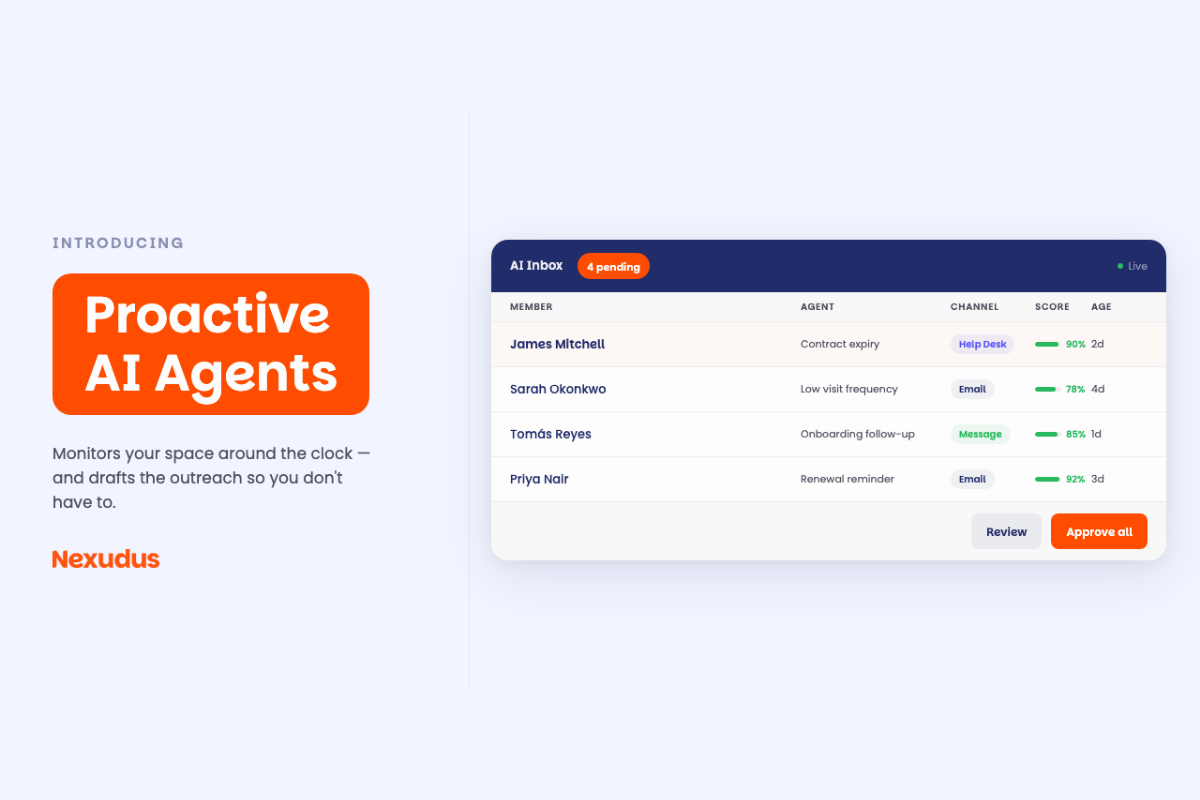
Today’s software is largely reactive. Users search for information, ask questions and trigger actions manually.
The next generation of software will be different.
It will be proactive.
It will identify opportunities, highlight risks and provide recommendations before users even know they need them.
Our AI journey has evolved from machine learning models that forecast meeting room demand to intelligent agents that support operators, members and teams across every stage of the workspace experience.
As AI continues to evolve, we believe the most successful organisations will focus less on the hype and more on practical outcomes. That’s been our approach from the beginning, and it continues to guide the way we build, innovate and evolve AI at Nexudus.


Want to know more about
how Nexudus could help your business?
We’re here to answer any questions you have.
Latest articles
-

- Coworking
- Coworking Resources
There’s No Excuse Not to Catch Retention Risk Early
Jane Robathan on September 3, 2026 -
- Coworking
- Coworking Resources
What To Include In Your Monthly Coworking Report
Emily Nguyen on September 3, 2026 -

- Coworking Resources
- Technology
- Uncategorized
Where are your workspace bookings coming from?
Jane Robathan on September 1, 2026