- Coworking
- Coworking Resources
What if the future coworking space isn’t built around desks?
For a long time, we designed offices around one basic assumption:
Work happens at a desk, in front of a screen, in a fixed place.
But the way people work has changed.
Over the past two weeks, I took part in Coworking Tech Week and the Coworking Values podcast. During the conversations about the future impact of AI, one idea really stood out:
The future office will be deskless.
Not because desks will disappear.
But because they will stop being the centre of the experience.
The big screen is no longer the anchor
A “deskless office” is not a workspace without desks.
It is a workspace where people no longer need to organise every part of their day around a desk, a monitor, or one fixed place.
AI is accelerating that shift.
More work can now happen on the move: from a phone, a small screen, a voice command, a quick prompt, or a short interaction between meetings.
The big screen still matters.
But it is becoming one interface among many, not the centre of the workday.
The question is whether our spaces, and the experiences around them, are designed for work in motion.
Most workplaces still think in desks
For decades, the desk was the default unit of workplace design.
If someone had a desk, they had a place to sit, a surface to work from, and a screen to focus on.
The rest of the space was designed around that assumption.
But that model is starting to break.
AI is making more work possible away from the big screen: on a phone, in motion, between conversations, or through quick interactions that do not require returning to a desk.
That changes the design question.
The future coworking space is not asking:
“How many desks can we fit?”
It is asking:
“How many different modes of work can this space support?”
Work depends on context, not a screen
Work is no longer just a place.
It is an intention.
“I need focus.” “I need my team.” “I need to host someone well.”
The screen still matters.
But it is no longer the anchor.
AI shifts the question from where people work to what they need to do next.
Design the space around the moment, not the desk
The next wave of workplace AI is not just automation.
It is interpretation.
People do not want to book resources. They want an outcome:
“I need quiet.” “I need my team together.” “I need this client visit to feel smooth.”
The workspace should understand that intent and respond with the right mix of space, access and services.
Because the desk was never really the product.
The product is momentum: the work people move forward, and the community that helps them do it.
What the deskless office looks like in practice
In a deskless office, the experience is motion-first.
It is built for people who work as they move through the space.
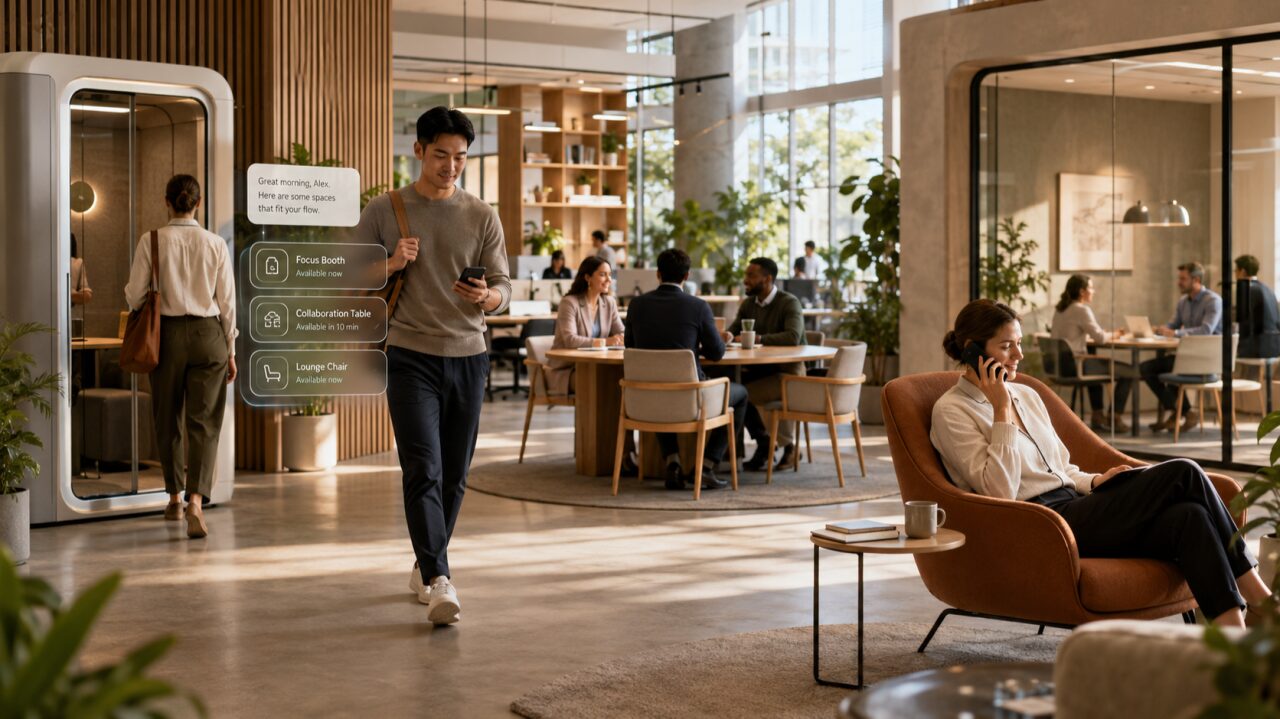
A member should be able to walk through reception and be guided by the workspace around them:
“A quiet room is available in 10 minutes.” “A project table is ready now.”
They should be able to confirm by tap, voice, or assistant.
Not by turning one visit into three separate tasks.
The work remains digital.
But the experience is no longer centred on one screen.
What operators need
The operators who win this shift will be the ones who understand behaviour, not just inventory.
They will design spaces around how people actually move through the day:
focus, collaboration, privacy, hosting, transition and community.
Technology matters because it has to support that reality.
It should help members move between rooms, services, access, parking and guests without turning one visit into a series of separate bookings.
The experience should feel fluid, not fragmented.
This is not about removing desks.
It is about removing the assumption that desks are the organising principle.
The payoff: a workplace built for movement
The deskless office is not the absence of desks.
It is a better match between people, space and purpose.
AI can help connect what a person needs with what the workspace can offer.
For operators, that means designing around movement and context.
For members, it means the office starts to feel like it was built around how they actually work.
What operators should ask next
The question is not:
“Do we still need desks?”
Of course we do.
The better question is:
Should the desk still be where work begins?
If yes, the workplace remains organised around yesterday’s assumptions.
If no, it can support a future where work moves across settings, the screen is one interface among many, and AI helps people find the right place for the task.
The deskless office will not arrive by removing desks.
It will arrive when desks stop being the organising principle.


Want to know more about
how Nexudus could help your business?
We’re here to answer any questions you have.
Latest articles
-

- Coworking Resources
- Technology
What Makes Coworking Software Agent-Ready?
Jane Robathan on July 14, 2026 -

- Coworking
- Technology
What Is White Label Coworking Software? A Guide for Workspace Operators
Emily Nguyen on July 13, 2026