


- Coworking
- Coworking Resources
Coworking AI: The Value of Space Is Mostly in Your Head
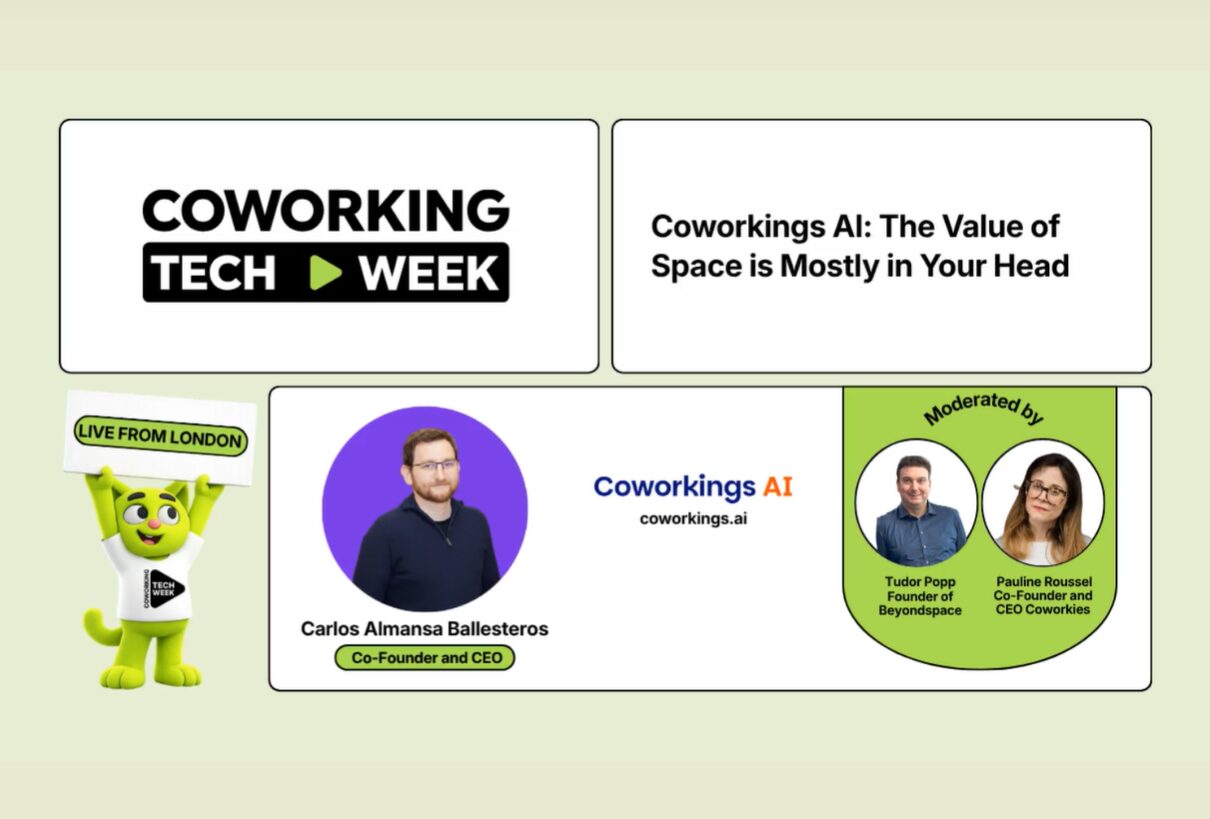
At Coworking Tech Week, Carlos sat down for a conversation that started with software and AI – but quickly became something much more interesting.
Beneath the discussion about automation, agents, dashboards, and machine learning was a deeper question:
What actually makes a coworking space valuable?
Not the desks.
Not the booking systems.
Not even the coffee.
The answer, increasingly, lives in perception, psychology, energy, and human experience.
Or as the conversation indirectly revealed:
The value of space is mostly in your head.
And AI is about to reshape that value in ways the coworking industry is only beginning to understand.
Coworking Is No Longer Just About Physical Space
For years, coworking operators competed on tangible things:
- Square footage
- Meeting rooms
- Location
- Design
- Pricing
Software existed mostly to support operations:
bookings, billing, memberships, access control.
But AI is changing the relationship between operators, members, and space itself.
Carlos described how coworking platforms are evolving from simple management systems into intelligent operational layers capable of:
- Surfacing behavioral patterns
- Predicting demand
- Identifying disengaged members
- Automating support
- Dynamically adjusting pricing
- And eventually enabling conversational interfaces with the workplace itself.
Because the more operational friction disappears, the more the feeling of a space becomes the product.
AI Can Automate Tasks But Not Atmosphere
One of the most important points Carlos made was:
“The intelligence lies with the operator and the team.”
That distinction matters.
AI can identify trends in member feedback.
It can summarise complaints.
It can recommend actions.
But it cannot truly understand:
- Body language
- Energy
- Emotional dynamics
And that’s the paradox emerging in coworking right now:
The more technology automates operations, the more valuable human atmosphere becomes.
The Real Product of Coworking Is Emotional
During the discussion, there was a fascinating moment about fully automated coworking spaces.
No reception desk, staff and human greeting.
Efficient? Definitely.
Scalable? Probably.
But something felt off.
Because coworking has never really been about access to furniture.
People join spaces because they want to feel:
- Productive
- Motivated
- Connected
- Inspired
Those are psychological states.
And psychological states are shaped by human interaction far more than software.
A chatbot can answer:
“How do I connect to the Wi-Fi?”
But it cannot notice:
“You seem exhausted today — rough week?”
That emotional layer is where the true value of coworking increasingly lives.
AI May Actually Make Hospitality More Important
There’s a common fear that AI will strip humanity out of workplaces.
But Carlos argued almost the opposite.
The original promise of coworking software back in 2012 was simple:
Automate repetitive tasks so operators could spend more time with people.
AI extends that idea dramatically.
If systems can:
- Handle repetitive support questions
- Analyse engagement
- Monitor operational issues
- Process data instantly
then community managers gain something incredibly valuable: attention.
And attention is the foundation of hospitality.
The best operators will win because AI gives them more capacity to:
- Notice people
- Anticipate needs
- Personalise experiences
The Workspace Itself May Change Completely
One of the most thought-provoking parts of the conversation explored what happens if laptops themselves become less central to work.
It sounds futuristic — until you realize how quickly AI interfaces are becoming conversational.
Carlos imagined a future where people interact with AI constantly through voice, agents, and mobile systems rather than traditional desktop workflows.
If that happens, coworking spaces may physically transform.
Instead of rows of desks, spaces could become:
- Collaboration zones
- Brainstorming environments
- Private AI conversation booths
- Flexible creative studios
In other words:
Coworking may become less about “where you work” and more about “how you think.”
And that’s where the title of this conversation starts making sense.
AI Is Forcing Operators to Re-Examine Their Entire Business
One of the smartest observations from the discussion had nothing to do with futuristic technology.
Carlos pointed out that AI implementation forces operators to pause and rethink their processes entirely.
Because AI only works well when:
- Workflows are clear
- Operations are structured
- Context is well-defined
- And internal knowledge is organized
That means AI isn’t just adding tools.
It’s exposing operational chaos.
The operators who benefit most won’t necessarily be the most technical.
They’ll be the ones who deeply understand:
- Their community
- Their workflows
- Their positioning
- And the emotional experience they’re trying to create
The Future of Coworking Is Cognitive, Not Physical
For years, coworking competed in the real estate market.
But AI may quietly push it into a completely different category:
the experience economy.
Because when operational efficiency becomes automated, physical infrastructure matters less.
What remains is:
- Trust,
- Creativity,
- Energy,
- Social identity,
- Belonging.
Things that exist mostly in the mind.
And ironically, that may make physical spaces more important than ever.
Not because of what they contain.
But because of how they make people feel.
The Most Important Insight From the Conversation
The biggest takeaway from Carlos’ discussion at Coworking Tech Week wasn’t that AI is taking over coworking.
It was this:
AI is turning coworking into a more human business, not a less human one.
The operators who thrive won’t be the ones replacing people with machines.
They’ll be the ones using machines to better understand people.
Because in the end, the value of space was never really the space itself.
It was always what happened inside people’s heads once they entered it.


Want to know more about
how Nexudus could help your business?
We’re here to answer any questions you have.
Latest articles
-
- Coworking News
- Coworking Resources
Stop Optimising Prices. Start Understanding Booking Behaviour.
Jane Robathan on July 30, 2026 -
- Coworking
- Coworking Resources
Multi-location Coworking Reporting: What Operators Need To See Across Every Site
Emily Nguyen on July 28, 2026 -
- Coworking
- Technology
How to Choose the Right Desk Booking App for Your Coworking Space
Emily Nguyen on July 23, 2026