


- Coworking News
Is The 9AM Space Race A Trap? Let’s Look At The Data

Every coworking operator in your market is fighting for the same customer, in the same window, with roughly the same product.
The Flexspace Observatory’s latest demand analysis makes this uncomfortably visible. In the UK, small operators receive 42% of their bookings at 9 AM. In the US, small operators go from single-seat bookings at 6 AM to eight-seat configurations by midmorning: a frantic compression of demand into the first few hours of the day.
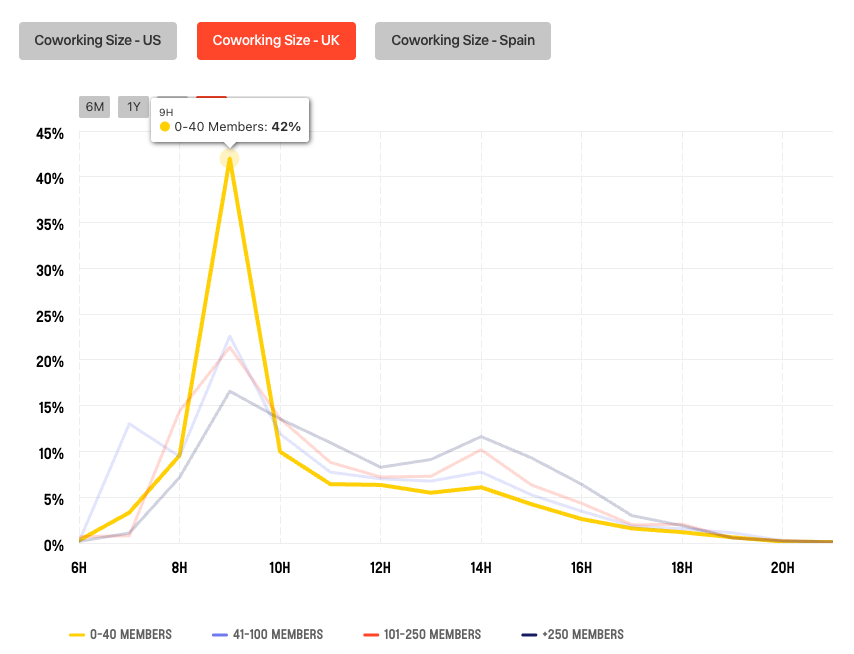
By early afternoon, most of those rooms are sitting empty.
Most operators read this data and think about how to capture more of the morning. That’s the wrong lesson. The morning is the most contested, most commoditised, most margin-compressed part of the day. Winning it harder doesn’t build a better business. It just makes you slightly less worse off than the operator down the street.
The smarter read is to look at where the data points to whitespace and build there instead.


The afternoon belongs to who wants it
Demand drops sharply across all markets by midday. In the UK, the cliff after 9 AM is steep and doesn’t recover. In the US the picture is more nuanced: there’s a secondary peak around 13-14H before demand tapers off through the afternoon. That secondary hump exists, it’s just never been built for.
But Spain tells a different story. After its own mid-afternoon dip to around 4% at 14H, demand rebounds to nearly 10% at 4 PM before tapering into the evening: a two-peak shape that consistently across every operator size. Spain hasn’t cracked the afternoon by accident. Its booking patterns suggest a customer base that has reasons to come back later in the day, and spaces that accommodate them.
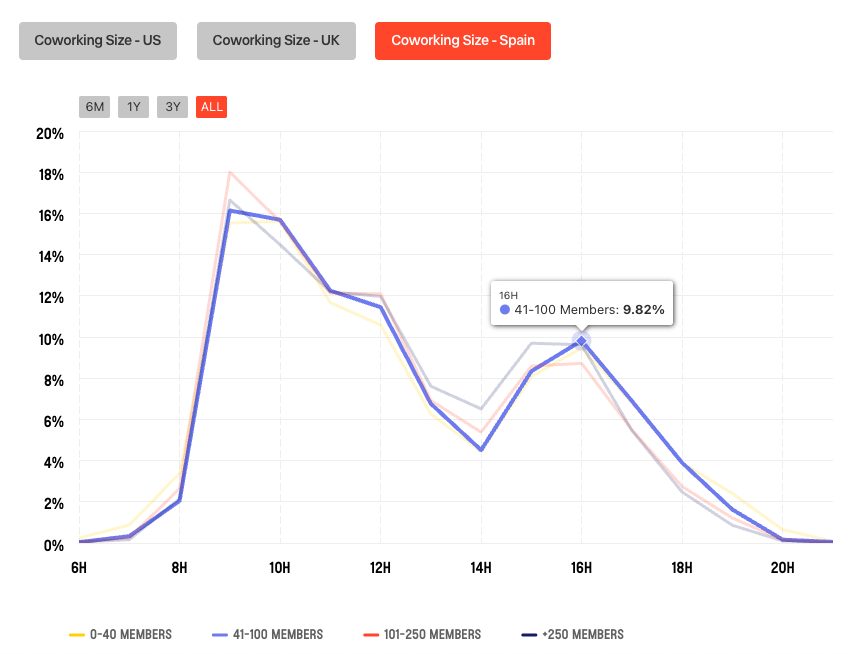
The US and UK haven’t built this. Meeting room formats, pricing structures, and marketing language all signal that coworking spaces are for the start of the workday. The afternoon customer, who might be a freelancer finishing deep work, a team running an offsite, or a remote employee who simply starts late, has never been handed a compelling reason to book at 2 PM instead of 9 AM.
Spain’s 4 PM rebound isn’t just a regional quirk. It’s evidence that afternoon demand can exist. The US secondary peak is evidence it’s already trying to. The question for operators is whether they’re willing to build for it deliberately rather than waiting for it to show up on its own.
The quiet signal in US ‘large room’ data
Buried in the US capacity findings is a number that deserves attention.
Rooms holding over 21 seats are approaching a 9% booking rate in the US, up from just over 7% previously. That’s a meaningful shift. And it’s opposite to how operators typically allocate space, with smaller rooms, more of them, higher booking volume, and better utilisation metrics on paper.
The problem with that model is that small rooms are also where competition is most intense. One- to three-seat configurations account for roughly 23% of US bookings. Four- to five-seat rooms add another 18%. Under-11-seat rooms make up around 70% of all bookings. The small-room market is crowded and getting more so.
The large-room recovery points to something different: enterprise teams, company offsites, collaborative sessions that don’t fit in a huddle room. These customers book less frequently but spend more per booking, require less hand-holding, and are less likely to churn to the next competitor who opens around the corner.
Most operators are under-indexed here because large rooms look inefficient on a per-seat basis (a metric problem, not a business problem). An operator who builds genuinely excellent large-format spaces and markets them to team buyers isn’t competing on the same terms as everyone else. They’ve opted out of the space race entirely.
The $22 gap is a conversion failure, not a pricing strategy
In the US, non-members pay around $74 per booking, while members pay around $52. That $22 gap has barely moved, but in the UK it’s down to $8, and in Spain it’s $12 and still falling. The instinct is to read the US gap as pricing power, but it maybe it isn’t.
Non-members aren’t paying a premium because they enjoy it. They’re paying it because the membership pitch isn’t convincing enough to make them stop. Europe is closing the gap. That’s not a market difference, it’s a sales difference.
It’s also worth noting how the UK gap is closing: not by lowering non-member prices, but by member rates climbing, from a long-term average near $80 to around $92 in the last six months. Members are paying more and still converting. That’s what a compelling membership proposition looks like.
The fix for US operators isn’t to lower non-member prices. It’s to ask why someone who books three times a month still hasn’t joined, and then actually fix it. That’s a product problem, a communication problem, maybe both. But it’s worth solving, because a converted member is more predictable, more loyal, and cheaper to keep than the person who keeps showing up at the walk-in rate and never commits.
Stop optimising for hours you share with everyone
The through-line across all three findings is the same: the coworking industry has collectively decided to compete hardest in the most crowded parts of the market, and to ignore the parts where competition is thin.
That’s not irrational; morning demand is real, visible, and easy to measure. Large-room enterprise buyers take longer to close. Afternoon positioning requires actual product thinking, not just a discount code. Non-member conversion is slower work than just keeping the premium wide and moving on.
But the operators who build durable businesses over the next five years won’t be the ones who won the 9 AM slot on a Tuesday in a dense urban market. They’ll be the ones who looked at what the data said was possible (not just what was easy), and built something nobody else had bothered to build yet.
The morning rush will always be there. The question is whether you want to spend your energy fighting for it.
*Data sourced from the Flexspace Observatory Demand Analysis report, March 2026. Analysis covers coworking and flex workspace markets in the US, UK, and Spain.*

Want to know more about
how Nexudus could help your business?
We’re here to answer any questions you have.
Latest articles
-

- Coworking
- Coworking News
- Technology
AI didn’t add a feature to coworking software. It’s rewriting what the product is.
Jane Robathan on September 30, 2026 -

- Coworking News
- Coworking Resources
Stop Optimising Prices. Start Understanding Booking Behaviour.
Jane Robathan on July 30, 2026 -

- Coworking News
- Technology
Everyone Wants to Use AI. So, Where Do Coworking Operators Start?
Jane Robathan on June 23, 2026