


- Coworking
- Coworking News
Why hot-desking deserves more respect

I still remember the first time I started hot-desking.
It wasn’t particularly pleasant.
I didn’t have a dedicated seat. Every morning meant choosing a different desk. I sat next to people I didn’t know. I had to adapt to their calls, their habits, and their noise. Phone booths weren’t common in coworking spaces back then, so distractions were part of the deal.
Some days it was frustrating. Other days, it felt inefficient. I missed the comfort of having my space.
And yet, something else happened.
I started recognising faces. Conversations began naturally. Someone asking how to connect to the Wi-Fi turned into a coffee. A casual chat led to discovering interesting ideas, projects, and people. Sometimes, those conversations even turned into collaboration.
Slowly, almost without noticing, I stopped feeling like someone renting a desk. I started feeling like I belonged.
As we grew, we moved into an office. It was the right decision. We needed more privacy, sharper focus, and room to grow.
But here’s the part that surprised me.
I sometimes miss the hot-desking days. What I miss most is the feeling of being embedded in the life of the space. Being exposed to people I wouldn’t normally meet became part of the experience. Even not knowing who I’d sit next to, and being okay with that, mattered more than I expected.
That experience shaped how I think about coworking today. And it’s why I believe hot-desking deserves a much more honest conversation.
The low-revenue label
Hot-desking has never enjoyed the best reputation among coworking operators.
It is often seen as the cheapest product in the portfolio. High churn. Low commitment. Hard to forecast. Admin-heavy.
Private offices are usually prioritised. Dedicated desks feel stable. Hot-desks are often treated as a stepping stone or a compromise.
From a purely financial perspective, this line of thinking is easy to understand. Revenue per square metre tends to be lower. Predictability tends to be weaker. If coworking were only about maximising yield, hot-desking would be the first thing to go.
But coworking isn’t just real estate.
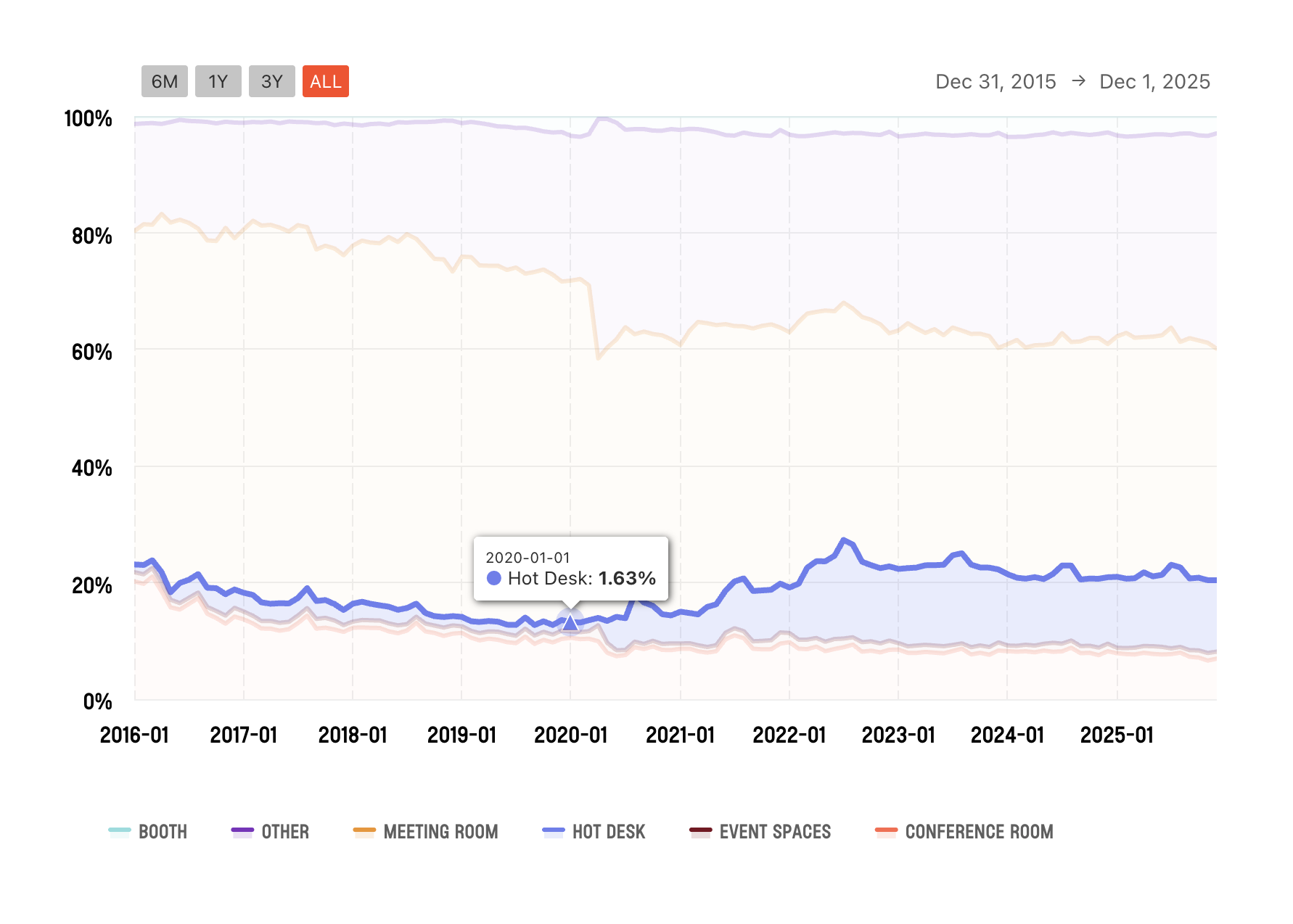
(See: Global Resources Demand – December 2025)
Hot-desking resources percentage in Coworking spaces (2016-2026)
Where community actually forms
If there is one thing my early hot-desking days taught me, it is this:
Community does not form in offices. It forms in shared friction.
Private offices vs hot-desks
Private offices create stability. Hot-desks create contact.
When people sit at hot-desks, they arrive without walls, physical or mental. They overhear conversations. They notice what others are working on. They ask questions without booking a meeting.
None of this is forced. That is why it works.
Events help. Common areas help. But hot-desks do something uniquely powerful. They create repeated, low-pressure interactions between strangers. You see the same people over and over again, without obligation.
Over time, trust forms quietly.
Not just for individuals anymore
Hot-desking has also outgrown its original audience.
It used to be seen as a freelancer product. Today, it is increasingly relevant to companies, particularly in a hybrid work environment.
Teams no longer show up consistently. Offices are rarely full, yet occasionally overcrowded. Companies want flexibility without resizing every six months.
Hot-desks solve that.
How companies can use hot-desks
For office-based companies inside coworking spaces, hot-desks become:
- overflow space on busy days
- desks for remote employees visiting occasionally
- flexibility without renegotiating contracts
Hot-desks stop being cheap desks and become elastic capacity.
How hot-desking is sometimes/often treated
Hot-desking is not the problem.
The issue is how it is sometimes/usually treated.
Uncomfortable chairs. Poor lighting. Awkward layouts. Little attention to acoustics or flow. Then it is easy to conclude that hot-desking is noisy, uncomfortable, and unsustainable.
Of course, it is if you design it that way.
The uncomfortable truth is not that hot-desking is cheap.
It is that we have been measuring it with the wrong lens.
Strong communities benefit from having shared desks. When hot-desking is absent, coworking can lose what makes it different.
Spaces may still work. They may even look polished. But without shared desks, the community becomes harder to build. Interactions happen less often. Familiarity takes longer. Everything feels more contained.
Hot-desks are a commitment to openness. To grow. To people sharing space before they share contracts.
I did not love hot-desking at first.
Over time, it became the place where I felt part of something bigger.
And that is something worth designing for.
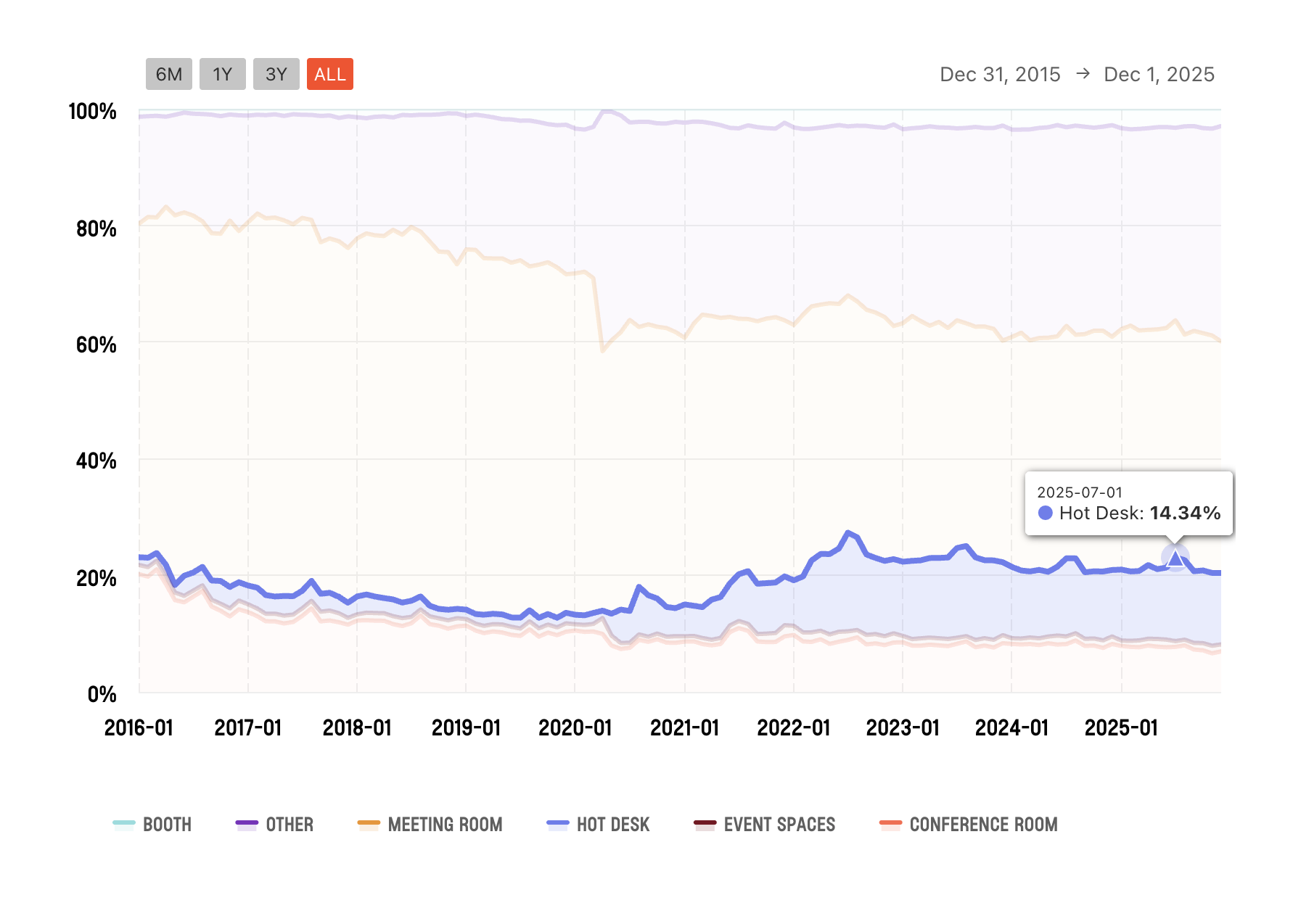
Hot-desking resources grew from 1.63% in 2020 to 14.34% in 2025. This growth highlights the increasing relevance and resilience of the hot-desking model within the coworking industry.
What this means in 2026
The temptation now is to treat the early 2020s as a closed chapter. The data suggests something more enduring.
What emerged over the past decade was not a temporary deviation, but a new operating context. Flexibility became a baseline expectation. Volatility became normal rather than exceptional. Operator maturity became measurable rather than anecdotal.
FlexspaceObservatory is not a benchmarking product designed to rank winners and losers. It exists to provide context and help operators, analysts, and journalists understand what the coworking and flex industry looks like today.
Explore the data yourself: FlexspaceObservatory.com
We will keep publishing what the data shows, even when it is less dramatic than the narratives built around it.

Want to know more about
how Nexudus could help your business?
We’re here to answer any questions you have.
Latest articles
-

- Coworking
- Coworking Resources
How to Monetise Every Part of Your Coworking Space
Kate Tattersfield on April 1, 2026 -

- Coworking
- Coworking Resources
Coworking Self-Service vs Staff Dependency: How the Member Experience Really Scales
Kate Tattersfield on March 30, 2026 -

- Coworking
- Coworking Resources
- Hybrid work
How to Launch Fractional Offices in Your Coworking Space
Kate Tattersfield on March 25, 2026